Who can Afford to be Apolitical: The Cinema of Tamil Eelam and Sri Lanka
by Priyanka Hutschenreiter
5 March 2026
Cinelogue is dedicated to representing cinema of the Global Majority and its distinct communities. The idea of the Global Majority—developed and propagated in the early 2000s by Black British educator and activist Rosemary Campbell-Stephens—reconfigures BIPOC (Black, Indigenous and People of Color) as a majority with shared intersectional experiences of racism and (neo)colonial oppression. Yet this presumed shared identity is rather felt and perceived by diaspora communities in the ‘Global North’ in confrontation with whiteness. Tensions, wars, and genocides perpetrated by communities of the Global Majority on other Global Majority communities persist. These take on deeply racist and imperialist tones.
The films of Sumitra Peries and Pradeepan Raveendran highlight this painful tension. Sumitra Peries (1934-2023) was a pioneer of Sinhala cinema in Sri Lanka*. Known as the poetess of Sinhala cinema, her work is defined by a tender social realism, depicting the lives particularly of Sinhalese women in rural Sri Lanka. Peries’ and her husband’s, Lester James Peries,’** works were some of the first to be featured on Cinelogue. While dedicated to the truths of social realities of the rural Sinhalese poor, Peries’ work stands in stark contrast, both in form and content, to the works of contemporary Eelam Tamil filmmaker Pradeepan Raveendran. His film Soundless Dance (2019) follows Siva, a young Eelam Tamil refugee in Paris, navigating precarity and racism as a refugee in France while continuously traumatised by the genocide of his people during the Vanni Massacre of 2009. Both filmmakers have been or are featured on Cinelogue, forming important contributions to Cinelogue’s library of films. The powers of both filmmakers highlight the profound chasm that haunts the peoples of Sri Lanka and Tamil Eelam, but also the tensions in Cinelogue’s own work contributing to transitional justice for Global Majority communities through film.
Here I draw on excerpts from an interview between Cinelogue and Sumitra Peries in 2022,*** seven months before her passing in 2023, and Sinthujan Varatharajah’s 2025 review of Pradeepan Raveendran’s Soundless Dance. The difference in the formats of these sources provides an interstice wherein what is obscured between the filmmakers’ practices and their respective communities can be witnessed. While creating in relation to the same physical island and space, the filmmakers’ and the communities they depict occupy completely different realities.
Peries’ work has had a predominant focus on social inequalities affecting women in Sinhalese Sri Lanka. Mostly without music and predominantly filmed analogue, her films became famous in Sri Lanka among Sinhalese communities for their emotionality and the beauty of the rural landscape.
“My central characters have always been female, the mother, the sister, and the family in the village. About middle class families, unfulfilled relationships, marriage. I have gravitated consciously or unconsciously towards women. Maybe because I am a woman, but basically, I didn’t go out to be didactic about the female experience. I was concerned about the anguish that a woman might go through due to social inhibitions due to social attitudes. Due to caste and class, all that has been my preoccupation.”

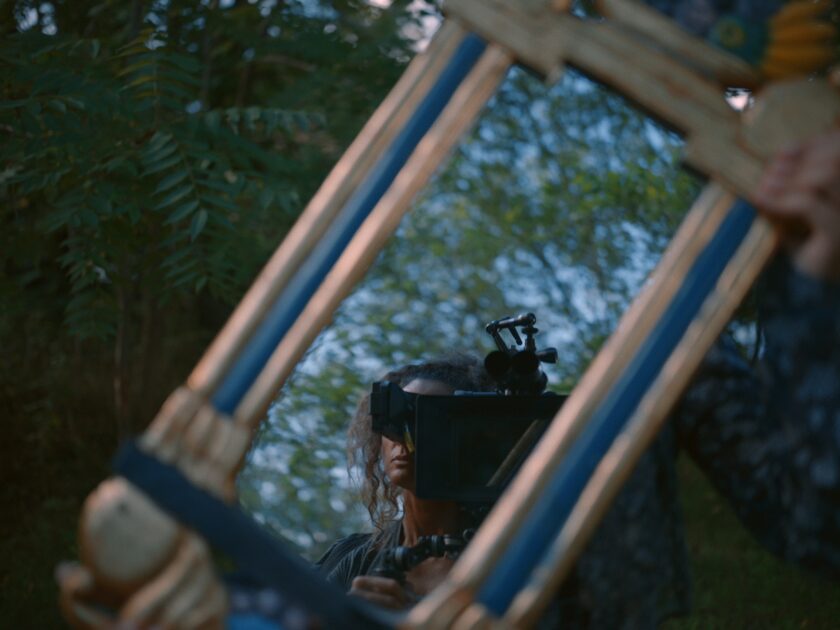
Sumitra Peries on set. Courtesy of Sumitra Peries.
Peries’ work and personal history reflect a life of relative social privilege as part of the dominant Sinhalese community of Sri Lanka. Born some 30km outside of Colombo into an upper middle-class family who valued education, art and social reform, her upbringing and education in Europe allowed her to navigate the world and filmmaking in a far more pleasant way than most women of colour at the time. She studied French for a year at the École de Français Moderne at Lausanne University and later lived for six months on a yacht in the South of France with her brother, a French artist friend and his American wife. She met her future husband, Lester James Peries, in Paris.
Pradeepan Raveendran currently lives in Paris, where many Eelam Tamil people have sought asylum and refuge after November 2005, “when the Sinhalese chauvinist Mahinda Rajapakse first came to power, and an end to the Norwegian-brokered peace talks between the colonial state and the independence movement became imminent. This was also a time when many Eelam Tamil asylum seekers were arriving in France…” (Varatharajah 2025). While Peries moved to France with relative ease and to further her education and world building, Raveendran’s protagonist, Siva, was forced to move for safety and security, and to support his family and community from afar.
Siva is physically in France, but simultaneously living in a state of constant connection to Tamil Eelam and his home, Killinoichchi. He is now not only living the life of a refugee under a foreign and, as they often are, xenophobic and racist state, but also with the continued violence of trauma of the colonial state of Sri Lanka on his people.
“By observing a genocide from outside its centre of violence, Raveendran manages to show how, when life can fall apart for some in the face of genocide elsewhere, the every day under racial capitalism forces the affected to continue to function almost unruptured and unmoved by that same violence.”
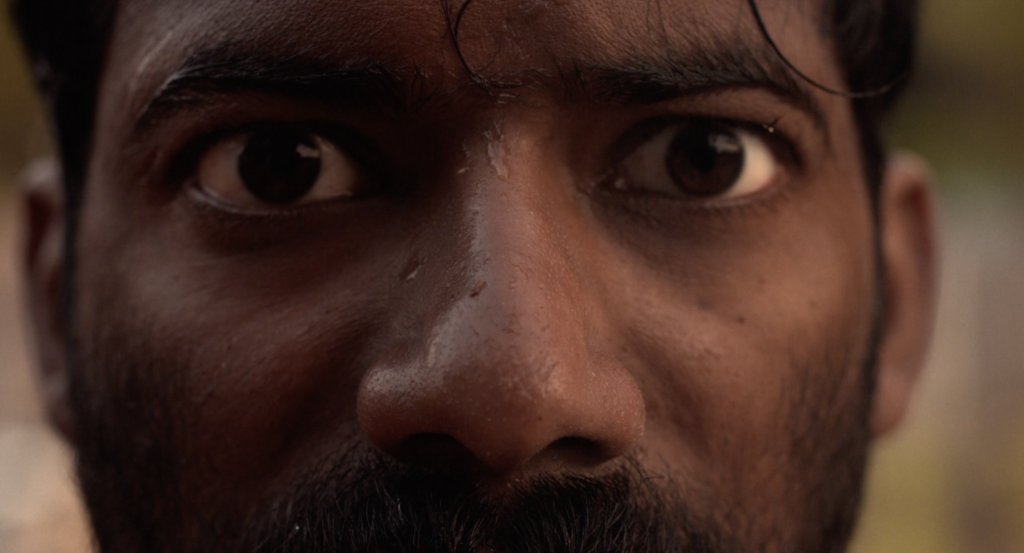
Close-up of Siva in Soundless Dance (2019) by Pradeepan Raveendran
Returning home is also a privilege less possible for Eelam Tamil people like Siva and filmmakers like Raveendran. In contrast, Peries returned home after finishing her degree in London. “My husband was starting a new film. Set during the time of the Portuguese. So that was a big film. I got a message asking whether I would like to come to work. I had been in Europe for three or four years. I longed to come back home. So I came back and started working. I was assistant director to start with.”
While some people have attributed her success to the support of her husband, Peries is firm and explicit in her understanding of her success as grounded in her efforts and labour. Peries’ words describing her experience of making films in Sri Lanka are romantic and warm, with a particular affection for the processes of capturing scenes on film, integrating sound and editing.
“The second film was Gamperaliya (1963, Lester James Peries), which I had written. And then I put some money in myself as I couldn’t get the right to do what I like to do otherwise. So I managed to get my finances right. I took to editing at a time when we used to edit the print, as you know. That means the sound was 19.5 frames ahead. When we had to adjust, we had to cut the negative because we couldn’t even cut several at the time when I started. There were no magnetic splicers to cut. We had to cut, scrape, and paste, which was a very tedious process. I have gone through all the processes in my career now. And now it’s electronic; with just a touch of a button, you have two shots put together. But in our day, we had to physically take one, hang it up, count the frames, and find the correct cutting point. I had installed an art reflex movie lens in the house, so it became like a cottage industry, where I could spend plenty of time on the work irrespective of schedules and call sheets and all that. I could stay in the house; the fishmonger used to come to the house, and I would do my house chores and my editing too.”
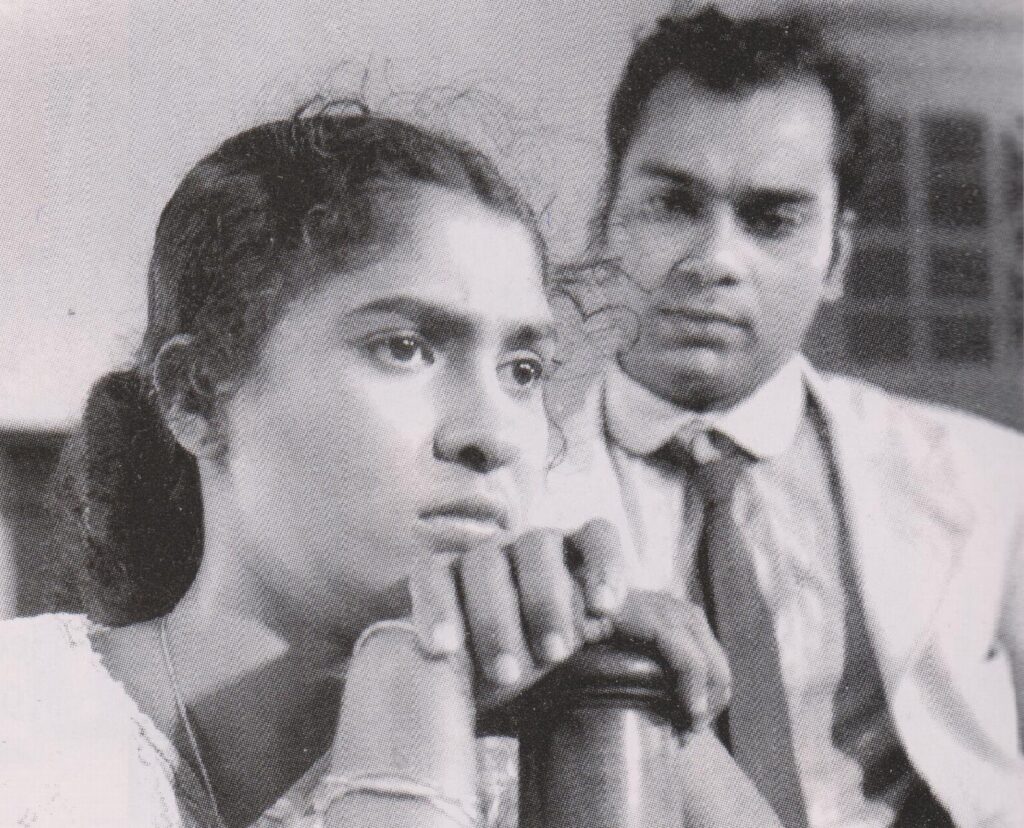
Gamperaliya (Changes in the Village, 1963) by Lester James Peries.
Peries’ romanticism—as evidenced in her nostalgia for the laborious filmmaking process of her time—is part of her social realism. Again, this is very much afforded by her family background and upbringing.
“I came from a fairly political family. Not fairly, very. My father’s brother had been to America. He came back. They call him the father of socialism. He is Philip Gunawardena, who is very well known in this country, and I guess a lot of it may have rubbed off, the socialist part of it, maybe the humanity, the kindness of human beings. So I feel I was privileged in the way I was born. But I haven’t abused it; I have used film to further whatever attitudes I had towards society…But I don’t believe in using the medium of film as a political tool. Because I think it should be implicit, not explicit. I don’t believe in social slogans…I’m not a social reformer, as such. But I am an emotional reformer up to a point. Emotionally I like to touch [people] in some way.”
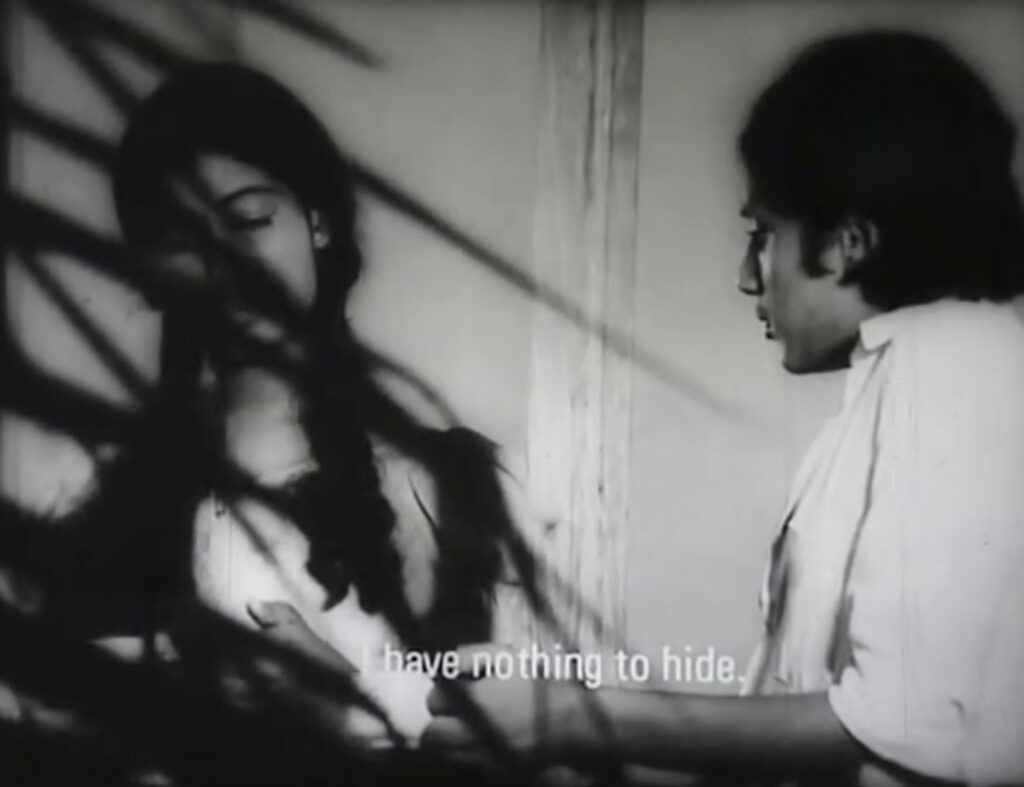
Gehenu Lamai (The Girls, 1978) by Sumitra Peries
I would argue that her films are political in their very nature of addressing social pain in the context of rural Sinhalese life in the mid to late 20th century. Her understanding of what counts as political was likely generationally defined. We just need to look at Wim Wenders’ recent shocking statement championing apolitical cinema at the 2026 Berlinale to trace how generational changes affect approaches to art making. Yet Peries recognises that romanticism isn’t available to everyone, “People are getting very desperate because it’s not easy to be gentle when circumstances are hard.” And while Peries promotes political subtlety—something I believe the Wenders’ of the world would find palatable—this is not something Raveendran can afford.
This is not to say his storytelling is on-the-nose. Quite the contrary: Raveendran has developed his own innovative visual language. Varatharajah’s description of the geography of the Eelam Tamil community’s dominant area around Paris’ Gare du Nord shows how Soundless Dance visualizes space to represent the way an exiled community continuously enacts remembrance and dealing with trauma:
“When carefully observing the walls between shop fronts, you will also quickly come to note obituaries put up for people who have died either at home or in exile. It is a way of conveying information on death that takes inspiration from Eelam and has also become widespread in exile. While connecting new geographies to old ones, this needs to also be seen as a response to the condition of forced mass displacement, in which the severing of personal ties through mass dispersion is counteracted by techniques that serve to inform, remind and reinforce ideas around community and social cohesion. On the way to meet his friend, Siva passes one of these walls and halts. He studies several obituaries hung for a number of people, some attached with coloured, some with black and white photographs.”
Siva is constantly looking out for news of the deaths of his close and loved ones, afraid to look but impossible not to look. Raveendran shows us the mobile footage Eelam Tamil people in Vanni were uploading during the genocidal massacre to document the atrocities for the international audience but also for their people witnessing the massacre from abroad. “In a desperate attempt to find evidence for his family’s survival, [Siva] returns home to search through more recent videos sent from Vanni. This became a common and daily practice for many situated outside of the besieged area, fearing for their relatives’ safety.”
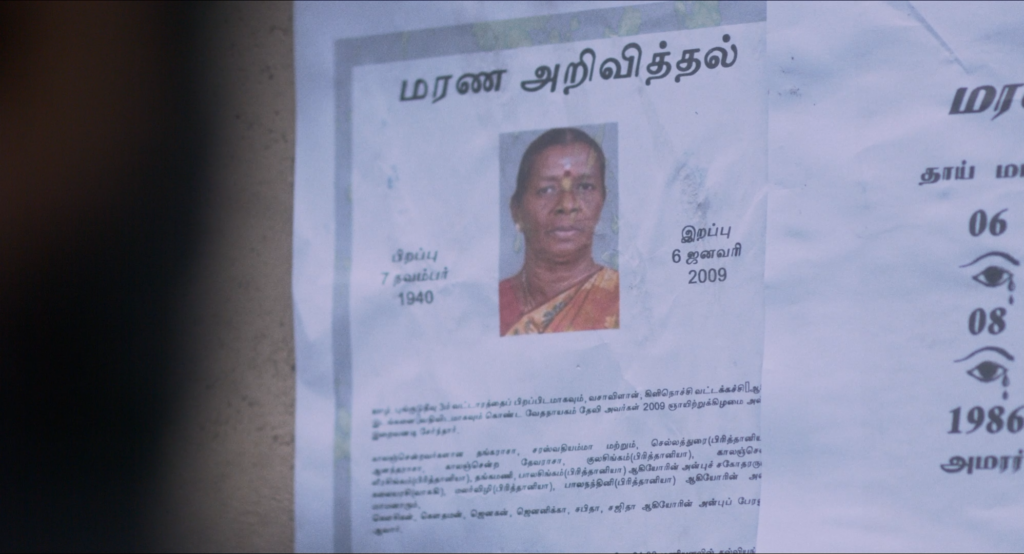
Still from Soundless Dance (2019) by Pradeepan Raveendran.
Through Siva, we—people not of Tamil Eelam—finally become witnesses also, for a brief moment.
“In the film, the protagonist dictates our point of view, forcing us to confront questions of proximity, safety and affect from this particular angle, helping us to understand that to live a genocide is a distinct hell, but to watch the genocide of your own people from afar isn’t an entirely different hell, but a segment of that same hell designed by perpetrators. In the case of the 2008-2009 Vanni genocide, displaced Eelam Tamils weren’t just forced to watch the annihilation of their homes and people from afar, but also the wiping out of all physical traces of their dream of political independence.”
The emotional tenure of Peries’ and Raveendran’s films are markedly different, though they share the qualities of avoiding music and focusing on the everyday. While Peries sought to convey social inequalities through everyday experiences against the backdrop of rural nature, Raveendran’s aesthetic never had the option of being this clean. The experiences and everyday life of a Parisian Eelam Tamil refugee are marked by an urban European aesthetic that alienates its inhabitants, particularly those without state, social and familial protection. As Varatharajah describes the social malaise of Eelam Tamil around 2009,
“Symptoms of depression, sleeplessness, and eating disorders, all indicating a collective mental health crisis, were common at the time. Self-harm, including suicide, was also a daily affair, reminding us that no statistic will ever mirror the real scope and depth of such violence on a people.”
This generational trauma haunting a community is exacerbated by the alienation of the European city, both a ‘refuge’ and completely estranging simultaneously—a violence of its own kind.
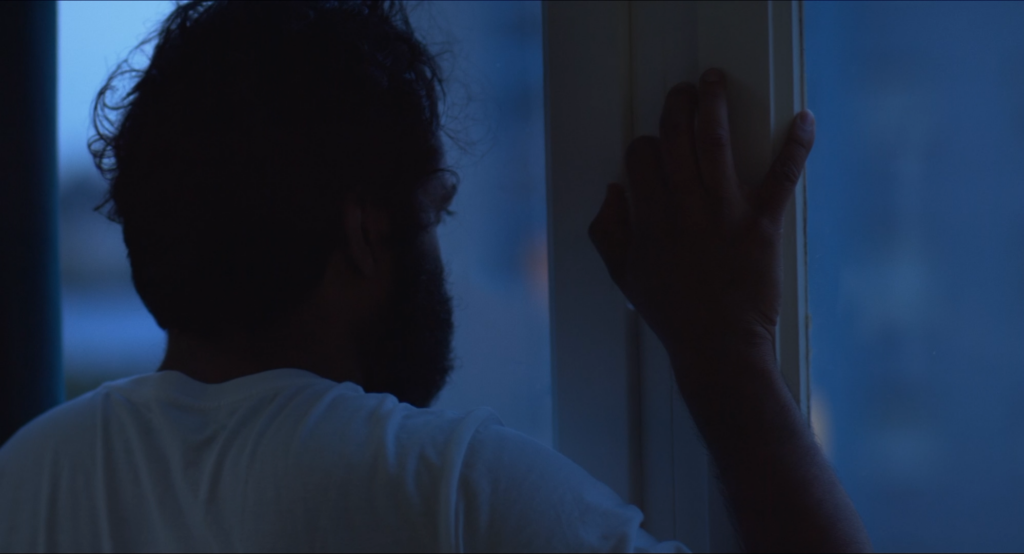
Still from Soundless Dance (2019) by Pradeepan Raveendran.
Both filmmakers focus on social trauma and “anguish”, in Peries’ words. But whereas Peries opts for subtlety, a gentle tone, and the absence of politics—as she sees it—Raveendran is preoccupied with a movement for the sovereignty of his people that continues to be denied, causing fractures not just between Sri Lanka and Tamil Eelam, but within his own community: flashbacks in Soundless Dance show us that Siva and his best friend fell out over their stances on military conflict for the independence of Tamil Eelam; and Eelam Tamil people are divided across continents for economic ‘stability’ and safety. Being apolitical is not an option available to Raveendran. No film can address the breadth of pain a plural place like the island of Tamil Eelam and Sri Lanka holds, yet we need to allow films to hold space for the emotional, social and mortal cost of politics if we are going to have any hope of justice and solidarity amongst the wider Global Majority now and in the future.
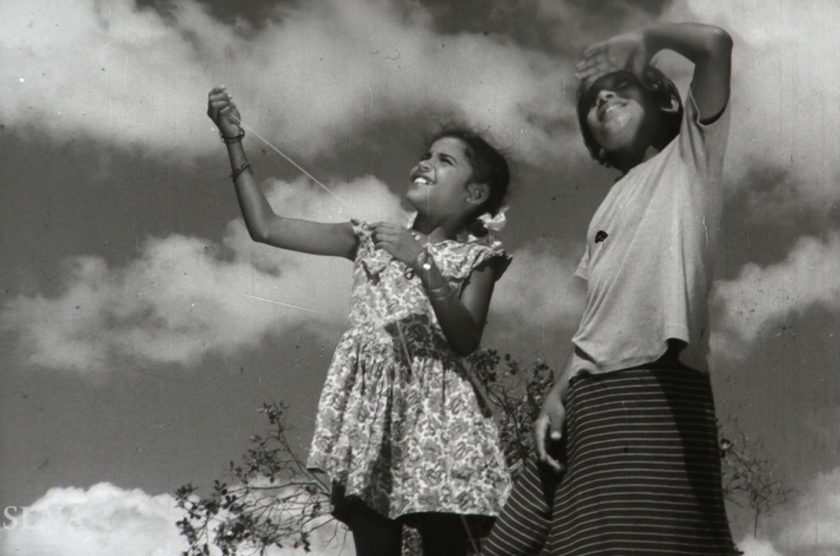
Sri Lanka, 1956, 1h 29m
film no longer available